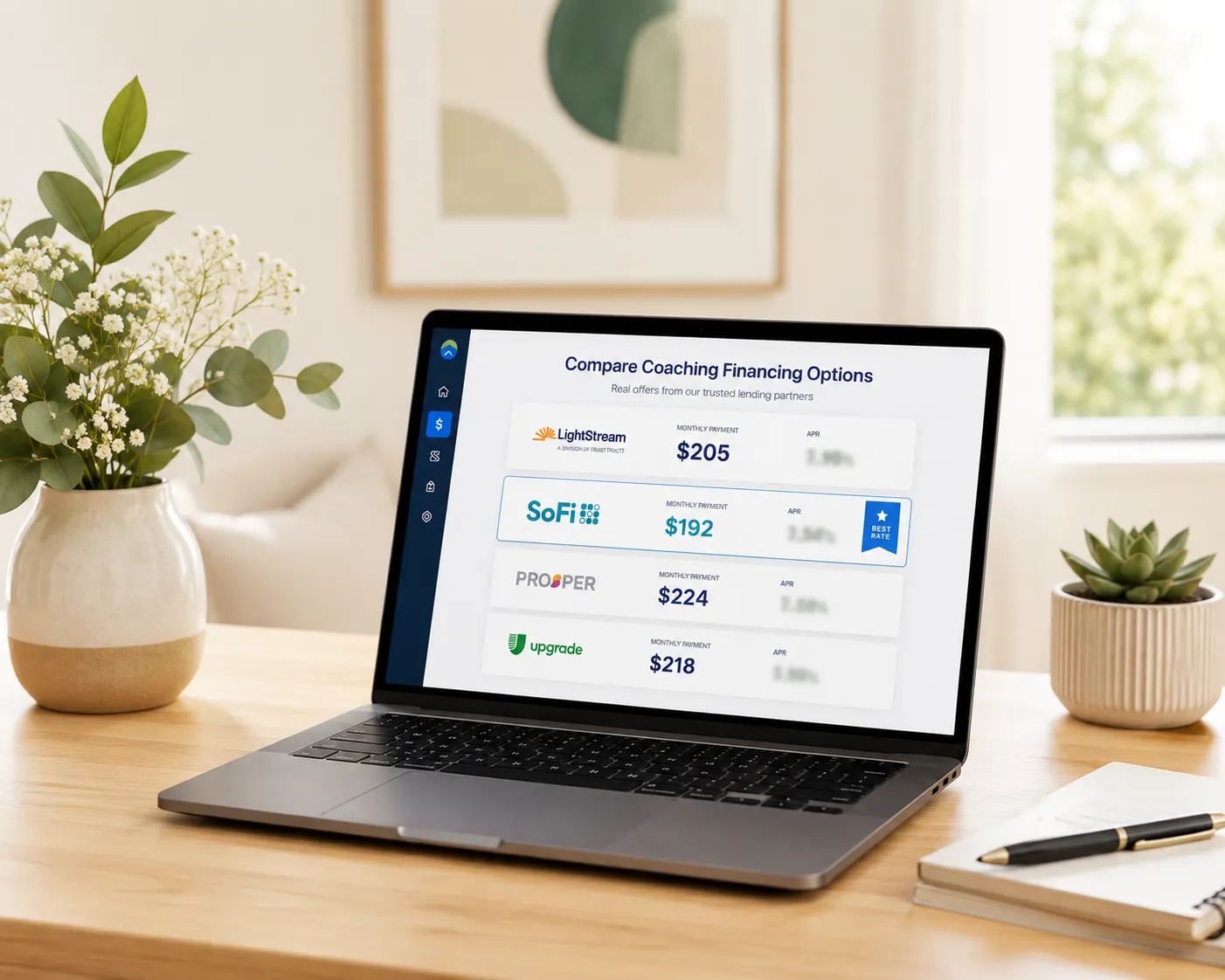

Turn Price Objections into Signed Coaching Clients
Advertising Disclosure
Executive Coach Financing Guide: How to Offer Monthly Payment Options & Scale Enrollment
Executive coaching programs can be a significant investment, with many engagements costing several thousand dollars or more. While many clients recognize the value of professional coaching, paying the full amount upfront is not always practical.
Executive coach financing allows qualified clients to spread the cost over manageable monthly payments instead of making one large upfront payment. This can help coaching businesses reduce price objections while allowing clients to begin working toward their leadership and career goals sooner.
With that said, financing is not the right solution for everyone. Approval depends on the participating lender, interest rates and repayment terms vary, and borrowing increases the total cost of the coaching engagement.
Understanding how executive coach financing works can help both coaches and clients make informed decisions before moving forward.
Why High-Ticket Executive Coaching Clients Prefer Payment Plans
Executive coaching is no longer limited to senior leaders at large corporations. Entrepreneurs, physicians, attorneys, consultants, sales professionals, managers, and people preparing for leadership roles now hire coaches for help with communication, decision-making, team management, business growth, and career transitions.
At the same time, clients have become more comfortable using installment credit for professional services. The Federal Reserve separates consumer credit into revolving credit, such as credit cards, and nonrevolving credit, such as installment loans. Its Consumer Credit G.19 report tracks continued borrowing across both categories.
This does not mean every coaching client needs financing. Many can pay in full. Some prefer monthly payments because they do not want one purchase to reduce their available cash by a large amount.
Consider an executive who has $25,000 in accessible savings and is considering a $10,000 coaching engagement. Paying in full may be possible, but doing so would consume 40% of those reserves. The client may decide that keeping more cash available is worth paying interest, particularly if income is variable or a large tax payment is approaching.
Another client may look at the same offer, calculate the interest cost, and decide to pay upfront. Both decisions can be reasonable. The answer depends on the client’s financial position and the actual financing terms, not just whether the client can technically afford the fee.
How Executive Coaching Financing Works
The exact process depends on the financing provider and participating lender, but it usually follows a familiar sequence.
1. The coach introduces the payment option
The coach explains that qualified clients may be able to pay over time. The financing option may be presented during a sales call, included in a proposal, added to a website, or shared through a custom application link.
The coach should not promise approval, a particular rate, or a specific monthly payment unless that information comes from an actual lender offer.
2. The client checks available options
The client submits basic personal and financial information through a secure application. Some financing programs begin with a soft credit inquiry so the applicant can check potential offers without an initial effect on the credit score.
A soft inquiry is not the same as final approval. The lender may request more information and may perform a hard credit inquiry if the client proceeds with a specific offer. The application and lender disclosure should explain when that occurs.
3. The lender evaluates the application
The lender reviews the applicant under its own underwriting standards. The coach does not make the credit decision.
Depending on the lender, the review may consider credit history, income, employment, existing debts, requested amount, credit utilization, recent applications, and other information.
4. The client reviews the offer
If one or more offers are available, the client can review the annual percentage rate, monthly payment, repayment period, fees, and total cost.
The lowest monthly payment is not automatically the least expensive offer. A longer term can reduce the payment while increasing the total interest paid.
5. The lender completes final verification
The lender may verify identity, income, bank information, employment, or the client’s enrollment in the coaching service. Missing or inconsistent information can delay funding.
6. The coach receives payment
Once final requirements are met, the lender may pay the coaching business directly. The client then repays the lender under the loan agreement.
This separates the coaching relationship from loan servicing. The coach does not have to send monthly financing statements, collect principal and interest, or pursue overdue loan payments.
Types of Executive Coaching
Executive coaching includes several specialized areas, each designed for a different career stage, leadership challenge, or organizational need:
- Leadership Development Coaching: Strengthens executive presence, emotional intelligence, communication, and strategic leadership. It is well suited for new managers, directors, and emerging senior leaders preparing for greater responsibility.
- Performance Coaching: Focuses on productivity, execution, time management, accountability, and measurable results. It is often used by sales leaders, managers, and professionals working toward ambitious performance goals.
- Executive Transition Coaching: Helps leaders clarify their role, manage stakeholders, build credibility, and gain momentum early in a new position. It is especially valuable for newly promoted executives, first-time C-suite leaders, and professionals changing industries or career paths.
- Strategic Coaching: Develops long-term thinking, business vision, decision-making, and organizational planning. It is designed for founders, CEOs, and senior leadership teams responsible for growth, transformation, or market expansion.
- Behavioral and Mindset Coaching: Addresses self-awareness, communication habits, conflict management, resilience, and leadership behavior under pressure. It is a strong fit for leaders who want to improve their interpersonal impact and adapt more effectively to change.
- Team and Collaborative Leadership Coaching: Builds trust, psychological safety, cross-functional alignment, and stronger team dynamics. It is ideal for executives leading complex, remote, matrixed, or rapidly growing teams.
- Career and Specialized Executive Coaching: Covers career strategy, personal branding, board readiness, crisis leadership, cross-cultural management, and industry-specific challenges. It is best suited for executives pursuing board positions, major career transitions, or highly specialized leadership roles.
Executive Loan Eligibility: How Lenders Evaluate Client Credit & Income
Many applicants focus almost entirely on credit score. That number matters, but it rarely tells the whole story.
A lender is trying to answer a broader question: How likely is this person to repay this amount under the proposed terms?
The decision may include several parts of the applicant’s financial profile.
Credit history
Lenders may review payment history, account age, recent late payments, collections, bankruptcies, credit utilization, and the number of recent credit applications.
A strong score does not erase every concern. Someone with a high score but rapidly increasing debt may still receive less favorable terms.
Income and employment
Income helps a lender estimate repayment capacity. Some applicants may be asked to provide pay stubs, tax documents, bank statements, or other proof.
Self-employed executives and business owners may face more documentation because their income can be less predictable than a fixed salary.
Existing monthly obligations
A high income does not guarantee approval. Lenders also look at how much income is already committed to housing, vehicles, credit cards, personal loans, and other debts.
Two applicants can earn the same salary and receive different offers because one has substantially higher monthly obligations.
Requested loan amount
An applicant may qualify for a smaller amount but not the full price of the coaching engagement. Requesting only the amount needed, rather than automatically applying for the maximum available, may produce a more manageable payment and lower borrowing cost.
Comparing Client Financing Options
Clients who do not pay in full generally consider three choices: a credit card, an in-house payment plan, or third-party financing.
Credit cards
A credit card may be convenient, particularly when the client already has enough available credit or qualifies for a temporary promotional rate.
The risk appears when the balance remains after a promotional period ends or when the card has a high variable interest rate. Minimum payments can also keep a balance outstanding longer than expected.
Credit cards may work best for clients who have a clear plan to repay the charge quickly. They may be less suitable for someone who already carries revolving balances from month to month.
In-house payment plans
A coach may allow the client to divide the fee into several monthly payments. This can be simple at the beginning, but it changes the business relationship.
The coach becomes responsible for billing, failed cards, late payments, collection messages, and decisions about whether services should continue when payments stop.
An internal plan may also delay the coach’s cash flow. The client receives coaching now, while the business waits months to collect the full fee.
Third-party financing
Third-party financing creates a separate agreement between the client and lender. If the lender approves and funds the transaction, the coach may receive payment upfront while the client makes monthly payments to the lender.
This can reduce collection work for the coach, but it does not guarantee that the client will receive attractive terms. The rate and cost depend on the lender’s offer.
Evaluating Total Loan Costs: APR, Term Lengths, and Monthly Payments
Monthly payments receive the most attention because they are easy to understand. They are also easy to misuse.
Suppose one offer has a payment of $430 for 24 months and another has a payment of $245 for 60 months. The second option may look more comfortable, but the borrower could pay much more interest over five years.
Clients should compare at least five numbers:
- The amount financed
- The annual percentage rate
- The monthly payment
- The number of payments
- The total amount repaid
The annual percentage rate, or APR, is especially useful because it reflects the cost of credit in percentage terms and may incorporate certain finance charges. The Truth in Lending Act requires covered creditors to provide specified disclosures about finance charges and APRs so consumers can compare credit terms.
A low payment may help cash flow. It should not be confused with a low-cost loan.
Hidden Lending Fees: Origination Fees, Prepayment Penalties, and Finance Charges
Interest is not the only possible cost.
Depending on the lender and product, a client may encounter an origination fee, late fee, returned-payment fee, or other charge permitted by the loan agreement.
An origination fee deserves special attention. Some lenders subtract it from the loan proceeds rather than adding it to the balance.
For example, a client approved for $10,000 with a 5% fee might receive only $9,500 in net proceeds, depending on the lender’s structure. If the full coaching fee is $10,000, the client may need to cover the difference separately.
Before accepting an offer, the client should ask:
- Is there an origination fee?
- Is the fee deducted from the proceeds?
- How much will the coach actually receive?
- Are there late or returned-payment charges?
- Is there a penalty for early payoff?
- Does the quoted APR include applicable finance charges?
Consumers can review federal credit disclosure requirements through the Consumer Financial Protection Bureau’s Regulation Z resource.
When to Recommend Financing to Coaching Clients
Financing may be reasonable when the coaching goal is defined, the payment fits comfortably within the client’s budget, and paying upfront would reduce needed cash reserves.
It may also make sense when timing has real value.
A leader who is preparing for a promotion interview in six weeks may not benefit from postponing coaching for a year. A business owner facing a team crisis may believe that waiting carries its own cost.
That does not mean every hoped-for business result justifies borrowing. Coaching outcomes are uncertain. A lender still expects repayment even if the client does not receive a promotion, increase revenue, attract new customers, or achieve the expected result.
Financing may be a better fit when:
- The client has stable income and adequate emergency savings.
- The monthly payment does not interfere with essential expenses.
- The coaching engagement has a clear purpose and defined scope.
- The client understands the full repayment cost.
- The client has compared financing with paying in full.
- The client is not relying on an uncertain future result to make the payments.
When Financing May Be a Poor Choice
Approval and affordability are not the same thing.
A lender may approve a payment that leaves very little room in the client’s monthly budget. The client is still responsible for deciding whether that obligation is prudent.
Financing may be a poor fit when:
- The client is already struggling with high-interest debt.
- The payment would reduce emergency savings contributions.
- The client expects coaching to produce guaranteed income.
- The rate makes the total repayment amount difficult to justify.
- The coaching scope, cancellation terms, or refund policy remain unclear.
- The client feels pressured to sign before reviewing the loan disclosure.
A good decision test is to imagine that coaching produces no immediate financial return. Could the client still make every payment without hardship?
If the answer is no, the financing may depend too heavily on an uncertain outcome.
Coaching Cancellations & Refunds: What Happens to the Loan Balance?
A loan agreement and a coaching agreement are usually separate contracts.
That creates an issue many clients do not consider until a dispute occurs.
If the coaching relationship ends early, the loan may not automatically disappear. The client may remain responsible for payments unless the coach issues a refund and the lender applies it to the balance according to the applicable process.
Before financing, the client should understand:
- Whether the coaching fee is refundable
- What happens if the client cancels
- What happens if the coach ends the engagement
- Whether unused sessions have a stated value
- How any refund is sent to the lender
- Whether interest or fees remain after a partial refund
Coaches should place cancellation and refund terms in writing before the financing application is completed. Financing should not be used to make unclear contract terms feel less urgent.
Is Executive Coaching Tax-Deductible as a Business Expense?
Clients sometimes assume executive coaching is automatically deductible because it relates to work. Tax treatment is more limited and depends heavily on the client’s status, the purpose of the expense, and current tax rules.
The IRS states that qualifying work-related education generally must maintain or improve skills needed in the taxpayer’s current work or meet certain employer or legal requirements. Education that qualifies someone for a new trade or business may not meet the same test.
The IRS also notes that many employees generally cannot claim unreimbursed job-related education as an itemized deduction under current federal rules, although exceptions and other education provisions may apply.
Self-employed individuals may face different rules when an expense is ordinary and necessary for an existing business. That does not make every coaching purchase deductible.
Clients can review IRS Topic No. 513 on work-related education expenses and IRS Publication 970, but they should speak with a qualified tax professional about their specific facts.
A hoped-for deduction should not be included in the affordability calculation until eligibility is confirmed.
What Coaches Must Disclose Before Offering Financing
A coach does not need to become a loan officer to offer financing. In fact, the coach should avoid interpreting credit decisions or advising clients which loan to choose.
The coach can still set accurate expectations.
Clients should understand that:
- Participating lenders make approval and pricing decisions.
- Checking options does not guarantee approval.
- Rates and terms vary by applicant and lender.
- A hard credit inquiry may occur if the client proceeds.
- The client should review all lender disclosures before accepting an offer.
- The financing agreement is separate from the coaching agreement.
- The loan must be repaid even if coaching does not produce a specific result.
Coaches should not advertise “guaranteed approval,” “no credit check,” or a universal monthly payment unless the statement is accurate for every applicant and supported by the lender’s terms.
Essential Questions Clients Should Ask Before Signing a Financing Agreement
A client should be able to answer the following questions before signing:
- What is the APR?
- How much am I borrowing?
- How much will I repay in total?
- How many monthly payments will I make?
- Is the interest rate fixed or variable?
- Is there an origination fee?
- Will any fee be deducted before the coach is paid?
- Can I repay the balance early without a penalty?
- When is the first payment due?
- What happens after a missed payment?
- Will payment activity be reported to credit bureaus?
- What happens to the loan if I cancel coaching?
If a client cannot find an answer in the disclosure, the client should ask the lender before proceeding.
A Practical Executive Coaching Financing Example
Imagine a senior sales director considering a six-month coaching engagement priced at $9,500. She is preparing to pursue a vice president position and wants help with executive communication, interview preparation, and a 90-day leadership plan.
She has enough money in savings to pay in full, but she also expects a large quarterly tax payment and wants to preserve her emergency fund.
She checks financing options and receives more than one potential offer. One has a lower monthly payment but a longer repayment term. Another has a higher payment but a lower total cost.
Before choosing, she compares the APR, fees, payment count, and total repayment amount. She also reviews the coaching agreement’s cancellation policy and confirms whether early repayment is allowed.
She decides that the shorter term fits her budget and saves enough interest to justify the higher monthly payment.
Another client might make the opposite choice or decide to pay in full.
The purpose of offering financing is not to push every client into debt. It is to provide qualified clients with another way to structure the purchase.
Key Takeaways
Coach Financing Solutions helps executive coaches offer client financing without becoming the lender, collecting monthly installments, or handling loan servicing.
Coaches can share a custom financing link by text, email, during a consultation, or through their website.
Clients can complete a secure application and review potential offers from participating lending partners rather than relying on a single payment option.
Once financing is approved and the lender’s funding requirements are met, the coach receives payment directly according to the applicable program terms. The client then repays the lender through scheduled monthly payments, allowing the coach to concentrate on the engagement rather than chasing invoices or managing a long-term payment plan.
If upfront pricing is preventing qualified prospects from saying yes, offering financing may help remove one of the biggest enrollment barriers. Learn how Coach Financing Solutions can help you provide flexible payment options while getting paid upfront.

Frequently Asked Questions
Yes, high-ticket executive coaching can be financed. Coaching businesses frequently partner with third-party consumer and business lenders to offer flexible monthly installment plans. Rather than paying thousands of dollars upfront, qualified clients can secure fixed-rate installment loans through participating financial platforms.
Executive coaches can offer financing by partnering with third-party merchant financing platforms or consumer lenders. Coaches share a secure, custom application link during sales consultations or on invoices. The partner lender manages credit checks, regulatory disclosures, underwriting, and monthly collections, paying the coach upfront minus any platform processing fees.
No, checking financing options does not initially hurt a client’s credit score. Most third-party coaching financing programs use an initial “soft credit inquiry” to pre-qualify applicants and show estimated rates. A “hard credit inquiry” – which may temporarily lower a credit score by a few points. only occurs if the client accepts an offer and completes a formal loan application with a participating lender.
There is no universal minimum credit score required for executive coach financing, as each participating lender uses its own underwriting criteria. While borrowers with prime credit scores (680 or higher) generally qualify for the lowest rates, many lender networks consider applicants across prime, near-prime, and subprime tiers starting as low as 580 to 600.
Yes, in most third-party financing arrangements, the coach receives payment upfront. Once a client’s loan is approved and funding requirements are finalized, the lender disburses the full coaching fee – minus any platform processing or merchant fees, directly to the coach’s bank account, typically within 1 to 3 business days.
Third-party installment financing is generally better for clients who need predictable, fixed monthly payments over 12 to 60 months. However, a credit card can be cheaper if the client qualifies for a 0% APR promotional rate and repays the full balance before high variable interest rates kick in.
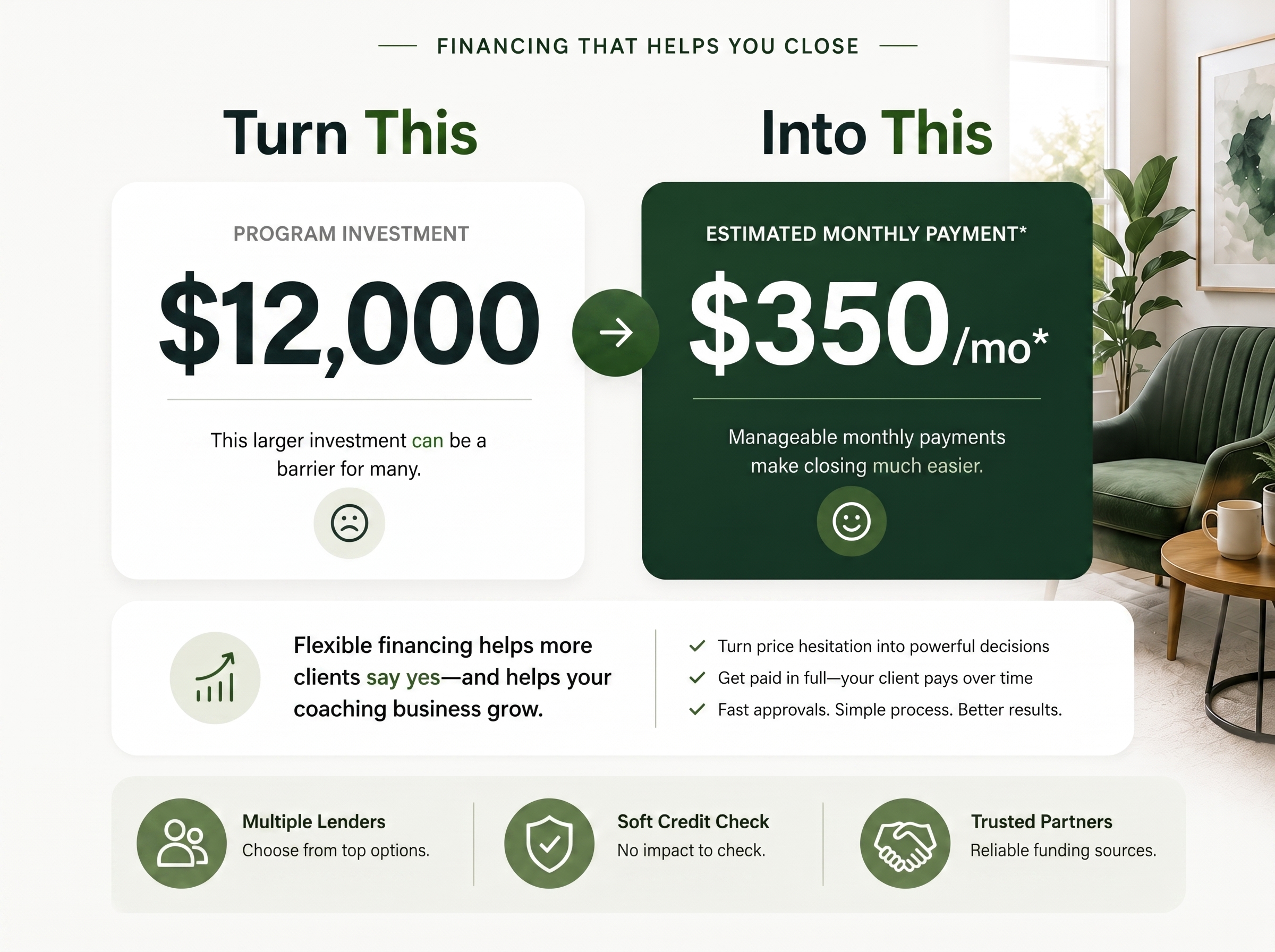

Simple, seamless financing built to grow your coaching business.

Coach financing doubled our high-ticket enrollments without touching our prices.
“Before introducing point-of-sale financing, we were losing qualified prospects on price objections alone. Now, our sales team gives prospects an easy, soft-pull payment option right on the call. We get paid 100% upfront, and our cash flow has never been stronger.”
David V.
Founder & Business Strategy Coach

No more chasing late payments or acting like a debt collector.
“Managing in-house payment plans was a nightmare for our team, and default rates were eating into our profits. Switching to Coach Financing Solutions completely removed our default risk. The lenders handle all ongoing billing, allowing us to focus entirely on client results.”
Elena R.
Mastermind Director & Health Strategist
Stop losing clients to price objections.
Offer monthly payments, get paid upfront, and eliminate the hassle of collecting client payments yourself.
Start offering financing.
Help clients compare payment plans in minutes so you can enroll more high-ticket clients on the spot.