

client funding
Business Coach Financing
Offer Monthly Payments for Business Coaching Clients
Remove one of the biggest barriers to enrollment by giving business coaching clients the option to pay over time.
- Finance from $1,000 to $100,000
Give qualified clients access to flexible payment options with fast online application decisions. 2
- Get paid in full & upfront
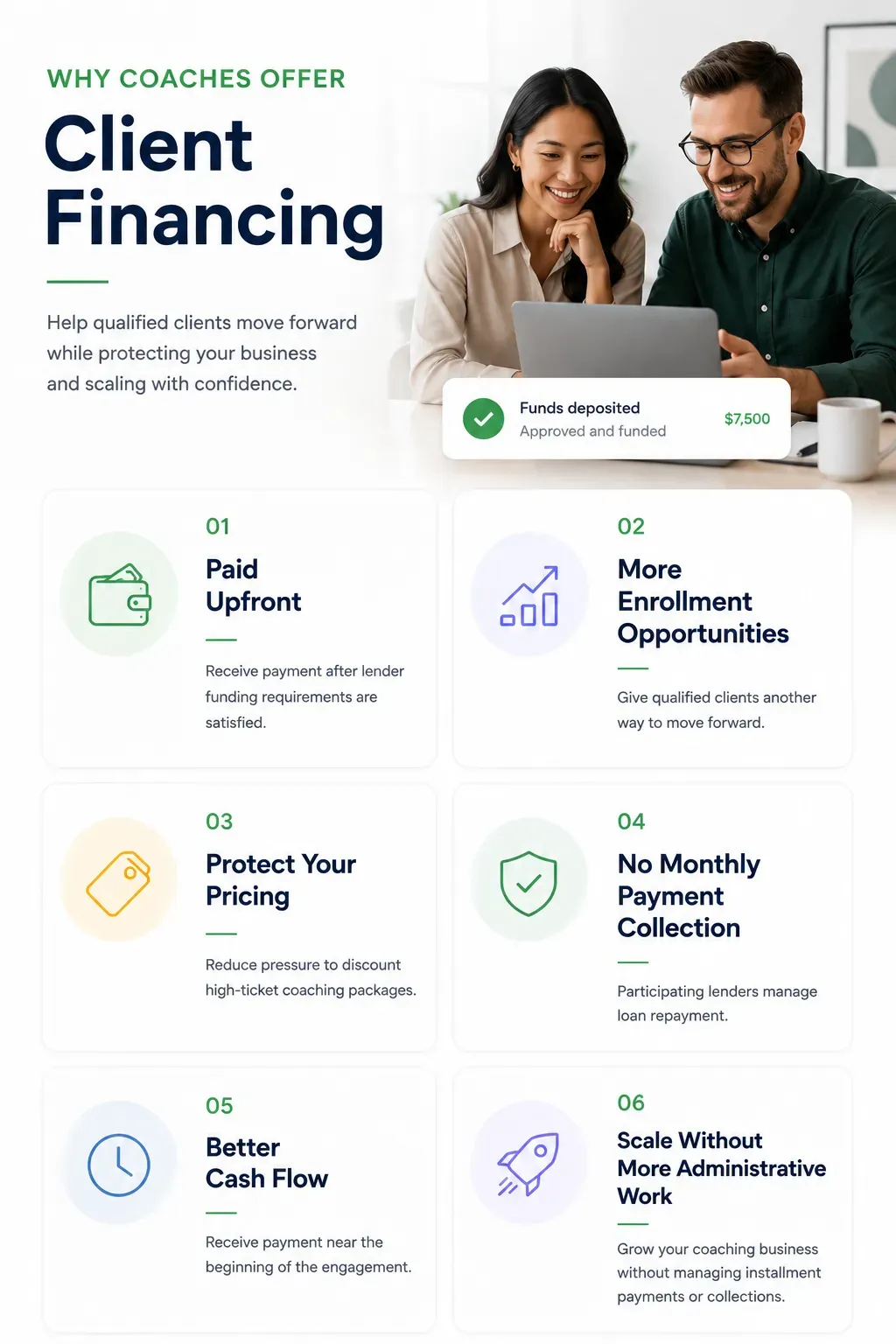
Receive 100% of your fee upfront while lending partners handle the loan and installments.

How to Offer High-Ticket Coaching Financing
Offering financing on a high-ticket coaching program can turn a “not right now” into a signed client, as long as you pick the right model and don’t accidentally become the bank.
You just spent forty-five minutes on a breakthrough call, and your prospect is sold, right up until you name the price: “I want this, I just can’t put down $10,000 today.” That’s the moment financing is built for. You have two ways to let a client pay over time: send them to Coach Financing, which pays you upfront and collects from the client for months, or run an in-house payment plan and collect the installments yourself. The one thing to settle first is who’s out the money if that client stops paying in month three. With Coach Financing, that’s the lender’s problem. With an in-house plan, it’s yours.
And here’s the trap: nobody got into coaching to play debt collector, yet that’s what an in-house plan becomes if you treat it as a scheduling detail instead of what it legally is, which is credit. The moment you let someone pay in more than four installments under a written agreement, federal rules can treat you as a lender with disclosure duties. So decide who’s actually lending, you or a licensed provider, before you split a price into payments. It’s a far easier call now than after a client disputes a charge.
Key Takeaways
- Coach Financing pays you upfront and shifts default risk to its lending partners, in exchange for a fee taken out of each sale.
- In-house payment plans keep more money per sale, but you carry any missed payments and, past four installments, you're likely subject to lending-disclosure rules.
- Retail buy-now-pay-later apps are built for smaller carts and often cap below high-ticket program prices.
- Whatever model you pick, put your refund and default terms in writing before you sell, not after a client disputes a payment.
How does high-ticket coaching financing actually work?
Here’s what happens behind the scenes when a client finances your program, because the mechanics are what decide your real cost. Financing just means your buyer pays the program off over time instead of in one lump sum. What separates the models is who fronts the money in between.
With Coach Financing, your client is approved through its lending partners, you’re paid the full program price upfront (minus a fee), and the client repays the loan in monthly payments directly. You get your cash in days. You never chase anyone. The cost is a merchant fee, a percentage of each financed sale that works like card processing but usually runs higher, plus whatever interest your client pays on the loan.
An in-house plan flips that around. You skip the outside lender and let the client pay you directly over a few months. You keep the full price minus your normal card fees, but you’re the one financing the balance, so if the client stops paying, that loss is yours. There’s a catch most coaches miss, too. Once your plan runs to more than four installments under a written agreement, the CFPB’s Regulation Z can treat you as a creditor with disclosure duties, even if you never charge a dime of interest.
Then there are retail buy-now-pay-later apps, the pay-in-four options you see at online checkouts. They’re fast and buyers already trust them, but most are built for smaller purchases and cap well below a $10,000 program, so they fit deposits or lower-priced offers better than full high-ticket enrollment. Their rules are unsettled right now, too: the CFPB issued 2024 guidance extending some credit-card protections to pay-in-four loans, then pulled it back in 2025, so check where things stand before you rely on one.
How the main financing models compare for a coaching offer
| Model | Who holds the default risk | Cost to you | Cost to client | Funding speed | Best for |
|---|---|---|---|---|---|
| Coach Financing | Coach Financing’s lending partners (non-recourse) | Percentage fee per sale, higher than card processing | Interest set by the client’s loan offer | Upfront, within days | Programs above roughly $5,000 |
| In-house payment plan | You | None beyond card fees, but you carry unpaid balances | Often interest-free if you don’t charge one | Spread across the plan | Lower-priced offers with steady volume |
| Buy-now-pay-later app | The app | Small per-transaction fee | Fees or interest that vary by app | Upfront, within days | Deposits or smaller sub-$2,000 offers |
Source: model mechanics per CFPB Regulation Z and provider terms. Costs described in relative terms; confirm current fees with each provider.
Should you run payment plans in-house or use Coach Financing?
Run it yourself or hand it to Coach Financing? It comes down to how badly you need the cash now versus how much risk you’re willing to sit on. Coach Financing costs you more per sale, but it takes your two biggest headaches off your plate: fronting the money and chasing late payments. An in-house plan keeps more of each sale, but every unpaid balance is money you’ve already delivered coaching against.
Picture the same $10,000 sale both ways. Through Coach Financing, you pocket a little less after the fee, but you’ve got the full amount in days and zero exposure if the client bails in month three. As an in-house six-month plan, you keep more, and you’re carrying $10,000 of delivered coaching on a promise, writing the overdue-payment email yourself. Not exactly why you started coaching.
Volume matters here too. Close only a handful of high-ticket clients a year, and one default on an in-house plan can swallow the margin from all the rest. Sell steady volume at a lower price, and in-house installments can work nicely, because no single miss sinks you.
The Margin Protection Rule: Price the financing fee into your offer before you launch, never after. If a lender takes a percentage of each sale, build it into your price the way you already account for card processing. Do it upfront and financing widens your enrollment. Bolt it on later and it quietly eats your margin instead.
Who's liable if a coaching client stops paying?
Say a client enrolls in January, you deliver two months of coaching, and in month three they vanish: no replies, no payments. Who eats that? If Coach Financing funded the deal on non-recourse terms, you already have your full payout and the disappearing act is the lender’s loss, not yours. That’s what non-recourse means in practice, and it’s the whole point of routing a high-ticket sale through a financing partner instead of carrying it yourself. Some setups are recourse instead, where the money can be clawed back from you when a client defaults, so confirm you’re on non-recourse terms before you assume you’re covered.
An in-house plan is recourse by definition, because you are the lender. That same vanishing client leaves you holding an unpaid balance and delivered coaching you’ll likely never be paid for, with little to do beyond collections or writing it off.
Chargebacks are a separate headache that blindsides a lot of coaches. A chargeback is a reversal a client’s bank starts when they dispute a charge, and an unhappy coaching client can file one even on a financed program. Your defense is a paper trail: a signed agreement, clear deliverables, and a written refund policy. Banks settle these disputes on documentation, not on how the coaching felt.
The Chargeback Reality: A financed sale is not chargeback-proof. Even when a lender paid you upfront, a client who put a deposit or an in-house installment on a card can dispute it, and card networks give buyers months to do so. Keep signed agreements, delivery records, and your refund terms on file for every single enrollment.
How to set up client financing in your coaching business
How you set this up depends on your price and how often you sell. A $3,000 program you sell every week can start with a simple installment feature right inside your existing checkout. A $25,000 mastermind you close on calls needs a real financing provider that can underwrite bigger balances and pay you upfront. Match the tool to the offer before you get lost comparing features.
What to look for in a coach financing provider
Not every provider is built for high-ticket coaching, and the differences that matter come down to three questions. The first is who carries the risk and what it costs you. Confirm the funding is non-recourse, so a client’s default is the provider’s loss and not yours, then get the full picture of what you pay: the merchant or discount fee per sale, any setup or monthly fees, and the rates your clients will actually be offered, since a steep APR can stall the very sale you’re trying to save.
The second is whether your buyers get approved and how fast you see the money. A provider that declines half your clients doesn’t help you, so ask how they handle thin or lower credit and how quickly you’re paid once someone is approved. The third is how it fits the way you already sell. Check that it drops into your checkout or works on a live call, and get in writing what happens to the loan and the fee if you issue a refund or a client disputes a charge.
How to add client financing, step by step
- Match the model to your price. Route high-ticket programs (roughly $5,000 and up) to Coach Financing on non-recourse terms, and keep short in-house installments for lower-priced offers. Either way, confirm the total fee and that the funding is non-recourse, not just the rate the client sees.
- Confirm the compliance basics. Financing touches lending law: Regulation Z requires you to disclose the APR and finance charges on consumer credit, FTC rules govern how you advertise finance terms, and some states add licensing or usury limits. Confirm what applies with a qualified professional and check your state’s rules before you launch.
- Integrate the link into your sales flow. Drop Coach Financing’s application link or checkout widget into your checkout page, proposal templates, and CRM; an in-house plan needs a billing tool that runs scheduled payments and a signed agreement behind it.
- Update your client contracts. Put your refund policy, deliverables, and what happens to program access if a payment fails in writing, tied to the agreement the client signs.
- Script the offer for your sales calls. Bring financing up right after you name the price, so it lands as a standard option and not a discount. Something plain works: “The investment is $10,000. Most clients either pay in full or spread it across monthly payments through our financing partner. Which fits you better?” Say it once, then let them answer.
Realistically, getting Coach Financing live on an existing checkout takes anywhere from a few days to a couple of weeks once you’re approved. A compliant in-house plan takes longer, because the paperwork and disclosures land on you.
Does offering financing actually increase enrollment?
Usually yes on high-ticket offers, because it clears the lump-sum objection, though how big the bump is depends on your price, your audience, and how you frame it. The logic is simple: someone who can’t cut a $12,000 check might not blink at a monthly payment that fits their budget. That’s not a reason to raise your price just because the payments look smaller, and it won’t rescue a program people don’t actually want.
Offer financing as one option, not the whole pitch, and keep the full price in view. Selling a program only in monthly-payment terms can wander into the deceptive-advertising territory the FTC watches. Put pay-in-full and financed side by side, and let the client choose.
The Enrollment Script Trap: Don't lead with "we have payment plans." It signals you expect people to balk and trains buyers to haggle. Bring financing up after you've established value, as a bridge and not a discount. Try: "You're clearly a fit for this. If writing one check today isn't ideal, we can set you up on monthly payments so you can start now." Then let them decide.
The Bottom Line
The right model really does come down to three things: your price point, how much cash you need now, and how much default risk you can stomach. Coach Financing’s non-recourse funding suits higher-priced programs and coaches who want their money upfront and would rather never send a collections email. In-house payment plans suit lower-priced offers with steady volume, where you’d rather keep the fee than offload the risk and you’re ready to handle the disclosures that come with lending. Retail buy-now-pay-later apps suit deposits and smaller offers more than full high-ticket enrollment.
One thing that’s easy to forget: financed sales can change when you owe tax on the revenue, depending on your accounting method, so check the timing with a tax professional and skim the IRS guidance on accounting methods if you’re unsure. Whichever way you lean, start by writing down two things: what you’ll do when a client stops paying, and what your refund policy is. Confirm the lending and tax details with a professional, then get your financing live before your next launch, not after buyers are already asking for it.
Ready to offer financing without turning yourself into the bank? Request a free proposal from Coach Financing to map out your setup, schedule a quick demo, and start giving clients a way to say yes on your next enrollment call.
Explore more high-ticket coaching financing options for business coaches
- Business Coaching Program Financing
- Executive Coaching Program Financing
- Leadership Coaching Program Financing
- Masterminds Coaching Program Financing
- Real Estate Sales Coaching Program Financing
- Sales Coaching Program Financing
- Small Business Coaching Program Financing
- Investing Coaching Program Financing
Start offering flexible financing to your clients today!
Disclosure: Coach Financing Solutions is not a lender and does not make credit decisions. Financing is provided by independent participating third-party lenders, which determine loan eligibility, approval, rates, terms, and funding. Submitting an application does not guarantee approval or any specific loan terms. Please review all lender disclosures before accepting an offer. The articles and information on our website are for general informational purposes only and do not constitute financial, tax, legal, accounting, or professional advice. Always consult your own advisors before making financial decisions.
Table of Contents
Stop Losing Clients Over Price.
Offer flexible monthly payment options that help qualified clients move forward while your coaching business gets paid upfront.

Offer coach financing to your clients.
Scale your high-ticket enrollments seamlessly. Let third-party lenders handle the underwriting and risk while you focus on coaching.
with multiple lending partners
direct to your bank account
(Prime, Near-Prime & Subprime)
amounts from $1,000 up to $50,000+
invoicing, or default risk
Services
Experienced best modern business advisors
Help executives, founders, and business owners invest in high-ticket coaching programs with more affordablemonthly payments.
- Executive Coach Financing
- Business Coach Financing
- Leadership Coach Financing
- Real Estate Coach Financing
- Mastermind Coach Financing
- Sales Coach Financing
- Small Business Coach Financing
- Trading & Investing Coach Financing
Offer seamless point-of-sale financing for career advancement, online academies, digital marketing accelerators, and professional certification tracks.
- Career Transition Coach Financing
- Marketing Coach Financing
- Course Creator Financing
- Sales Funnel Coach Financing
- AI Coach Financing
- Mindset Coach Financing
- Productivity Coach Financing
- Public Speaking Coach Financing
Support clients investing in high-ticket health, fitness, functional wellness, and performance programs with fast pre-qualification.
- Health & Wellness Coach Financing
- Nutrition Coach Financing
- Sports Coach Financing
- Fitness Coach Financing
- Recovery Coach Financing
- Menopause Coach Financing
- ADHD Coach Financing
Make life and personal transformation coaching programs accessible with predictable monthly installments.
- Life Coach Financing
- Relationship Coach Financing
- Divorce Coach Financing
- Spiritual Life Coach Financing
- Dating Coach Financing
- Personal Finance Coach Financing
Frequently Asked Questions
Coach financing works through a point-of-sale (POS) multi-lender financing software that allows clients to pay for high-ticket programs in flexible monthly installments while the coaching business gets paid 100% upfront. The process is simple:
Instant Pre-Qualification: Prospects complete a 60-second online application to review custom financing options from multiple lenders using a soft credit check with no impact to their credit.
Upfront Merchant Funding: Once the client accepts an offer and completes loan setup, the lender pays 100% of the tuition directly to the coach’s bank account via ACH within 24 to 72 hours.
Lender-Managed Servicing: The third-party lending partner assumes 100% of the default risk, ongoing billing, and loan servicing while the client repays the lender over fixed monthly terms (12 to 60 months).
Coaches can collect payment once the participant completes the financing process and the loan proceeds are deposited into the participant’s bank account. Funding typically occurs within 24 to 72 hours, although timing may vary by participating lender, funding method, and your merchant agreement.
Possibly. Our network of lending partners offers financing programs for a wide range of credit profiles, including approvals for qualified borrowers starting as low as a 600 FICO score. Each lender evaluates multiple factors, including income, employment, debt-to-income ratio, requested loan amount, and overall credit history.
No. With Coach Financing Solutions, checking available financing options begins with a soft credit inquiry, allowing clients to review personalized financing offers without impacting their credit score. If a client decides to move forward with a financing offer, the selected lender may perform a hard credit inquiry as part of the final approval process.
Yes, point-of-sale coach financing is fully compatible with 100% online coaching, virtual academies, and remote consulting models. The entire pre-qualification, underwriting, and loan execution process operates through a web-based, paperless workflow. Prospective clients can review personalized monthly payment options and complete electronic loan agreements remotely from any device with zero physical documentation required. This enables digital course creators and virtual coaches to enroll remote clients nationwide while receiving real-time application updates and full upfront merchant funding.
No. Once the participant accepts a financing offer, completes the lender’s funding requirements, and the coaching business collects the agreed program payment, the participant repays the participating lender according to the financing agreement they accepted. The coaching business does not collect the participant’s ongoing monthly loan payments.
Third-party coach financing eliminates default risk and administrative overhead while providing immediate cash flow, whereas in-house payment plans delay revenue and force coaches to act as debt collectors. Managing internal installments ties up working capital and often leads to high default rates on uncollected billing. In comparison, point-of-sale financing pays your coaching business 100% of the program fee upfront via direct ACH deposit, leaving the third-party lender to assume all credit risk, payment processing, and ongoing collection management.
Yes, offering point-of-sale financing can help increase high-ticket enrollment rates by reducing immediate out-of-pocket price friction for qualified prospects. Providing flexible monthly payment options alongside single-payment tuition allows budget-conscious prospects to manage cash flow more effectively during the purchasing decision. By making program investments more accessible without needing to discount services, coaching businesses can improve sales conversation outcomes while maintaining their core pricing structure.
Coaching customer financing supports virtually all premium, high-ticket professional services and program investments.
Primary high-ticket coaching categories and delivery formats eligible for third-party merchant funding include:
- Executive & Business Consultants: Corporate growth advisors, revenue strategists, B2B consultants, and executive leadership specialists where third-party financing solves immediate client cash-flow hurdles.
- Masterminds & High-End Group Creators: Elite mastermind memberships, cohort-based group mentorships, and scalable high-ticket courses that might otherwise price out prospects without flexible installment options.
- Health, Wellness & Longevity Specialists: Deep transformation programs, functional health mentorships, and longevity coaching whose high-value services typically lack traditional corporate or insurance backing.
- Career, Life & Specialty Coaches: Extended 1-on-1 life coaching, career pivot mentoring, specialized skill bootcamps, and vocational certifications where paying entirely out-of-pocket presents a major barrier to entry.
There is no single minimum credit score required for coach financing because eligibility varies across participating third-party lenders. Through a multi-lender network, qualified borrowers can access point-of-sale financing across a broad spectrum of credit profiles, including prime, near-prime, and subprime options (with approvals available for credit scores starting as low as 600 FICO).
Participating lenders use holistic underwriting and evaluate several financial factors alongside credit scores, including:
Gross Income & Revenue: Verified personal income or business earnings.
Debt-to-Income (DTI) Ratio: Total monthly debt obligations relative to gross monthly income.
Requested Financing Amount: Funding requests typically ranging from $1,000 to $50,000+.
Credit History: Overall payment reliability and status of active accounts.
Clients can check available loan options and monthly payment terms through an instant soft credit pre-qualification that has no impact on their credit score.
Start Offering Financing Today.
Help qualified clients compare payment options in minutes to complete enrollment faster.
- Turn hesitant prospects into committed clients.
- Flexible monthly payment options for your programs.
- Get paid upfront without carrying client payment default risk.